Start with a promise
you can put to the test.
A book idea becomes useful when it gives you something to write and something to leave out. A setting, a subject or an important experience can start the process. The next step is to find the question that will hold the material together. Treat the first answer as a working choice you can revise after making a few pages.
Find the pressure
For fiction, ask who wants something and why getting it is difficult now. “A story about a reading room” gives you a place. “A contractor must empty a reading room before noon, but finds a letter a regular visitor is still waiting for” gives you a situation with competing demands.
Choose a reader’s question
For practical nonfiction, move from a broad subject to a problem somebody recognizes. “Community repair” could fill many books. A handbook for a person arranging their first small repair event can select material around a clear sequence of decisions. The imagined reader helps you judge which explanation belongs.
Give the project an edge
Name a boundary. A first-event handbook need not become a complete history of repair, a business manual and a guide to every technique. A novel need not explain a town’s whole past before its first encounter. A boundary gives this version of the book a workable shape.

The Lantern Room
A contractor, a closing reading room and a letter that makes a simple job complicated. This invented story gives us material to work with throughout the workshop.
ONE PROMISE → ONE TEST → ONE NEXT STEPName the pressure.
A contractor clearing a closing reading room finds a letter meant for a visitor who still comes every Thursday. She wants to finish the job, but delivering the letter may challenge the decision that closed the room.
Write through a choice.
The visitor asks for the Thursday delivery while the removal van waits outside. Elin recognizes the handwriting and says she has not seen the letter. The scene ends with a deliberate omission that the next scene must answer.
Leave a specific entrance.
Next session: draft what Elin does when the visitor notices the empty shelves. Establish what she risks by keeping the letter. Mark any missing background instead of stopping the exchange to explain the building’s full history.
Make the idea specific.
- Write a two-sentence promise. For a story, name the person, the task and the complication. For nonfiction, name the reader, their starting difficulty and the change the book supports.
- List three things that belong and two that do not. If almost everything fits, make the promise more specific. If the idea feels too thin, look for a consequential decision or an unanswered reader question.
- Choose a sample you could draft next: an encounter, a worked explanation or a remembered moment. Let the sample test the promise before naming every chapter.
Keep the promise provisional. If the pages lead to a different central character or expose a missing explanation, update the brief and record why. Planning is useful when it helps you make and assess the work. It becomes a distraction when you spend every session protecting a plan you have never tested.
Your book.
One clear page.
Use your own answers to assemble a working brief. A provisional title is enough. The reader and promise matter more than a polished description.
Fiction or nonfiction? Start here.
For fiction, describe the experience you want to offer. For nonfiction, describe the reader’s difficulty and the change the book supports. Name one next passage you could actually write.
This exercise works in your browser. Fields are not saved when you leave this page. Download the brief to keep a copy.
Your working brief
Give the scene
somewhere to go.
A scene gives the reader a present situation to follow. Somebody tries to do something, meets resistance and leaves with a changed problem. A scene may be quiet; the change can be a realization, a withheld answer or a decision to wait. The important question is whether what happens affects what can happen next.

An invented scene: a letter in hand, an open doorway and a decision still to make.
Original editorial illustrationThe Lantern Room had been part of the town for almost a century. Many people had worked hard to keep it open, but the council had recently voted to close it. Elin had accepted a contract to clear the shelves and return the keys before Friday. She had complicated feelings about the building. On Thursday morning she found a letter behind the noticeboard. A visitor arrived a little later.
“Has the Thursday letter come?”
Elin stopped pulling the noticeboard away from the wall. The envelope in her pocket pressed against her wrist.
The visitor put his library card on the empty counter. “She said she’d leave it here.”
Behind him, the removal van blocked the window. Elin had promised the driver the room would be clear by noon.
“Not that I’ve seen,” she said.
An intention becomes visible
Elin wants to clear the room and finish the job. The visitor wants the letter. Those immediate aims let the reader understand the pressure without receiving the building’s entire history first. Neither person needs to explain the whole story aloud.
The setting does work
The empty counter, the noticeboard and the removal van are useful details because they shape the exchange. The noon deadline makes delay matter. A beautiful description can remain, but it earns its place by changing the experience of this moment.
The answer creates a consequence
“Not that I’ve seen” is an action: Elin chooses to conceal something. Now the writer has a specific problem to continue. What makes the lie difficult to keep? What could make her correct it? The next passage should develop that consequence.
What happens
after the lie?
This continuation adds a connection Elin cannot dismiss and makes her respond. It does not solve the mystery. Her question changes the exchange from a denial into an attempt to discover what the visitor knows. You could choose a different consequence; the useful test is whether the new information changes the action.
The visitor turned his card over. On the back, beneath a strip of yellowing tape, was a photograph of the room before the shelves were painted. Elin’s mother stood behind the counter.
“She used to keep the Thursday things separate,” he said.
Outside, the driver tapped his watch against the glass. Elin pulled the envelope from her pocket, keeping the address against her palm.
“Who told you there would be a letter?”
Chapters that earn
their place.
A chapter is a unit of progress. In a novel, it may bring a discovery, a reversal or a difficult choice. In a practical book, it may prepare the reader to make one decision. Give each chapter a job you can name, then arrange the jobs so that one prepares the reader for the next.
From a broad subject
to seven useful chapters.
Here is a complete working sequence for our invented first-event handbook. It demonstrates how to organize a book; it is not an operational specification for running an event. Each row names a question and a result. Material without a clear role can wait outside the outline.
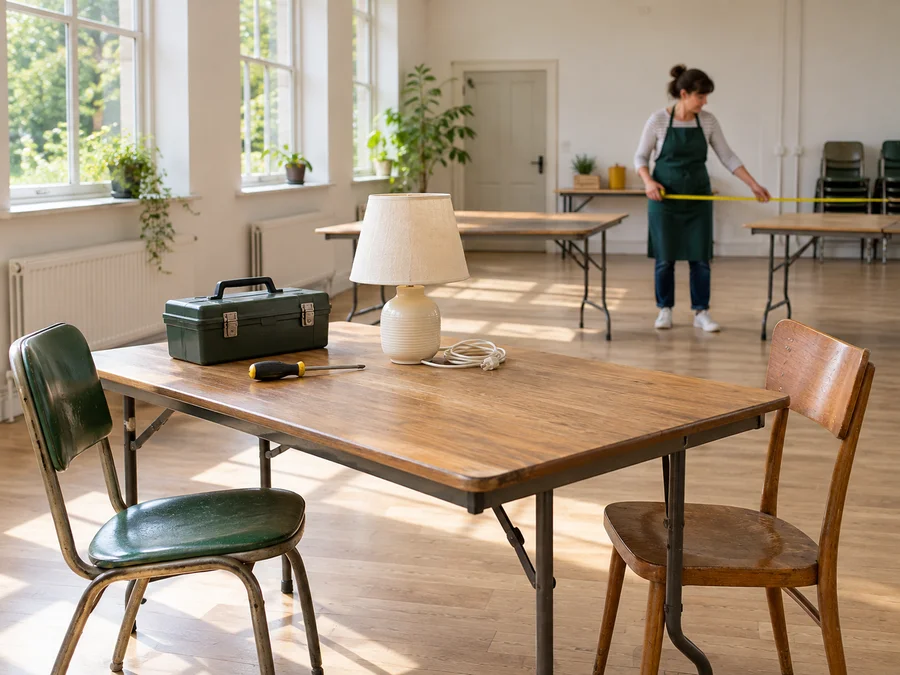
Give each chapter one question and one result. Then test what the sequence leaves out.
Original editorial illustration| Chapter | The reader’s question | What the chapter leaves them with |
|---|---|---|
| 01Define the first event | What kind of event are we trying to run? | A one-paragraph purpose, an intended group and a manageable scope. |
| 02Find the people | Which roles need an owner before planning continues? | A working role list, open responsibilities and questions for potential helpers. |
| 03Describe the activities | What do we expect to offer, and what still needs checking? | A provisional activity list with dependencies and limits clearly marked. |
| 04Compare the rooms | Which space could support those activities and people? | A comparison of candidate spaces using the same questions. |
| 05Plan the visitor’s route | What happens from arrival to departure? | A walk-through that exposes unclear handovers or missing information. |
| 06Prepare the final check | What must be confirmed before the event goes ahead? | A list of decisions, owners and unresolved questions to review. |
| 07Learn from the first attempt | What should change before another event? | A record of observations, feedback and a small set of proposed changes. |
Follow the choice,
then its consequence.
For fiction, map the change rather than assigning a topic. The reading-room story could begin with this short chain. Each event alters Elin’s next attempt, so the outline carries a developing problem instead of a list of locations.
- 01
Find
Elin discovers a letter while clearing the room. Finishing the contract now competes with finding out whom the letter concerns.
- 02
Conceal
She tells the visitor it has not arrived. The choice protects her time briefly, but gives her something to hide.
- 03
Recognize
The visitor produces a photograph of her mother. She has a reason to investigate and must reconsider what the room means to her.
- 04
Ask
She reveals part of what she has found and asks a question. The next encounter must respond to the information she has chosen to share.

Write the memory.
Keep the uncertainty.
Writing from experience involves more than selecting dramatic events. You are shaping the distance between what happened, what you remember and what you understand now. A scene can carry sensory detail while acknowledging that a memory is partial. Keep the account of how you know something close to the material.
Remembered
“I remember waiting by the footbridge while my father went back for the bag. The boards felt warm under my bare feet.” This is a remembered experience. The warmth may be vivid, but vividness alone cannot confirm a date or another person’s exact words.
Documented
“The photograph is dated August 1998 on the envelope. It shows the footbridge before the handrail was replaced.” Record what the document actually establishes. A photograph may help place a scene while leaving the conversation and the reason for the journey unresolved.
Understood later
“At the time I thought he was annoyed with me. Now I wonder whether he was worried about returning before dark.” That is a present interpretation. Let the distinction remain visible instead of giving the younger self knowledge they did not have.
Choose the repair
before rewriting.
An awkward paragraph can point to several different problems. Name what the reader cannot follow, choose a small change and compare the result. These two invented examples show how a revision can change the work underneath the sentences.

A useful revision begins with a question about the draft, before it becomes a page of marks.
Original editorial illustrationThe scene ends where it began.
Mara waited outside the locked hall. She remembered the argument with her brother. The caretaker arrived and let her in. She sat down to think about what to say.
What needs attention?
The passage moves Mara into a room, but the arrival costs her nothing and reveals little. Polishing the description of the door would leave that problem in place. Ask what she wants to protect and how entering could make that harder.
The caretaker held the key above the register. “Sign here for the collection box.”
Mara looked at the empty square beside her brother’s name. The hall lights were already on; through the glass she could see the table where he had left the box the night before.
“Is it missing?” she asked.
“I’m asking who took it.”
She set her pen down. “Then you need a different form.”
The revised passage gives the caretaker a demand and lets Mara resist it. She enters an exchange that exposes a relationship and a risk. The wording may still need work, but the scene now contains a decision whose effect you can inspect in the surrounding story.
The example arrives before its purpose.
A chapter opens with a long story about a busy community event, then lists room sizes, then explains that a first-time organizer needs a way to compare venues. The reader meets details before knowing what to look for.
What needs attention?
The individual paragraphs might be clear. The sequence asks the reader to hold information without a question to organize it. A shorter opening anecdote alone would not necessarily fix that dependency.
Before comparing rooms, write down the event you expect the space to support. Who will be there, what will they do, and which facilities would that require? Use the same questions on each visit.
In our invented comparison, room A has movable tables but unconfirmed storage. Room B offers storage but a shorter booking. Neither observation chooses the venue by itself: first establish whether those differences affect the event you have described.
The new opening gives the reader a question before presenting the example. The room details now have a visible purpose. You could add more evidence or explanation later; the first repair is making the relationship between the decision and its supporting material clear.
Give each pass one main job.
Structure
Read the sequence and chapter jobs. Move, combine or remove material only after naming what the change should achieve.
Continuity and evidence
Check facts, character knowledge, chronology and the support for claims. A structural change can disturb details that were consistent before it.
Language
Read a smaller passage for clarity, rhythm and voice. Sentence work becomes easier to judge when the surrounding material has a stable job.
Ask for an observation you can work with.
“Is it good?” gives an early reader a difficult job. Send a manageable excerpt, explain the stage of the draft and ask about the experience you need to inspect. You are gathering evidence about the reading, then deciding what the manuscript needs.
For a story scene
“At what point did you understand what Mara wanted? Where did your expectation of her next action change?”
Ask the reader to mark a line or moment. Their account can reveal where an intention became visible, or where a choice felt unsupported. A suggested replacement plot is a separate idea you can evaluate later.
For an explanation
“What decision could you make after this chapter? Which step would you still need help with?”
This separates a pleasant reading experience from a usable explanation. Invite the reader to try the exercise and note the point where they need information the chapter has not supplied.
When notes disagree
“Which passage led you to that response, and what were you expecting at that point?”
Look for the underlying experience before counting votes for a change. Two readers may propose opposite repairs to the same unclear transition. Record the shared difficulty, test a response and keep responsibility for the final choice.
Close the loop with a revision note: the observation, your interpretation, the change to test and what you will read again afterward. You do not need to act on every suggestion. You do need a reason you can return to when judging the next version.
Know what supports the page.
Know what you decide.
Research and AI assistance solve different problems, but both need a visible trail of decisions. A source note connects an explanation to material you can examine. An AI request produces suggestions you still need to judge. Neither a saved link nor a fluent answer makes a claim reliable by itself.

Separate observations, source material and interpretation before building a claim.
Original editorial illustrationA source note you can return to.
For the handbook chapter, keep the question, the source location and the observation separate. “The room is ideal” is an interpretation. “The tables can be moved; storage was not confirmed during the visit” is an observation with an open dependency. The second note makes it easier to see what needs checking before you build a recommendation around it.
Take one research note and identify which words come from the source, which are your summary and which express your judgment. Add a page, section or other useful location. Then name the claim the note might support. If it supports none of the current chapter’s claims, keep it outside the draft for now.
- Question
- What do we still need to establish about room A?
- Source
- Site-visit notes, room A, page 2
- Observation
- Tables can be moved. Storage was not confirmed.
- Interpretation
- The layout may work, depending on the planned activities.
- Next check
- Confirm storage and revisit the comparison.
Ask for possibilities.
Keep the choice.
Suggest three obstacles to Mara returning a key without meeting her brother. Keep her wish to avoid him. Offer possibilities rather than drafting the scene, and do not add a new backstory.
These possibilities are an invented comparison, not a live AI response. The point is the evaluation. Choose the first option only if it fits the passage and character. Draft your own version, compare it with the original and record which assistance you used. Check factual suggestions against appropriate sources; never treat a generated citation as proof.
A practical obstacle
The caretaker needs a signature before accepting the key. This can put Mara into a difficult exchange using a person already present.
A social obstacle
Her brother has asked somebody to collect the key from her. This could work, but it requires the manuscript to establish that arrangement.
A new secret
The key opens a hidden room nobody knew about. This changes the scale of the story and introduces an unsupported premise. Set it aside unless that is a deliberate new direction.
A little time.
A specific piece of work.
A plan works better when the task matches the time and attention available. This illustrative week alternates preparation, drafting and review. Move the sessions, shrink them or take a break when your circumstances need it; the example is a starting arrangement, not a daily rule.

Make the session small enough to begin, and leave a clear place to return.
Original editorial illustrationFind the entrance.
Read the last two pages and the note you left. Choose one scene or explanation. Write down who wants what, or which question the reader needs answered. Gather only the material that could block this task.
A short brief and a named place to begin.
Make a rough version.
Draft through the exchange or the explanation. Mark nonessential gaps clearly. If a missing fact controls the outcome, stop to name that dependency rather than inventing an answer that makes the scene convenient.
A passage with an outcome you can describe.
Read and leave a trail.
Notice what changed from the plan. Choose one issue to inspect next: a missing consequence, an unclear transition or an example that does not support the point. Save the passage and a concrete return note.
One observation, one next action and a backup.
For a drafting estimate, divide remaining words by an observed words-per-session pace, then divide the sessions by sessions per week. Round up and leave room for interruptions. This estimates drafting only; research, revision and feedback need their own time.
For example, 30,000 words at 500 words per session need 60 sessions. At three sessions a week, that is 20 drafting weeks before allowing for interruptions. If the observed pace changes, update the estimate rather than treating it as a deadline.